
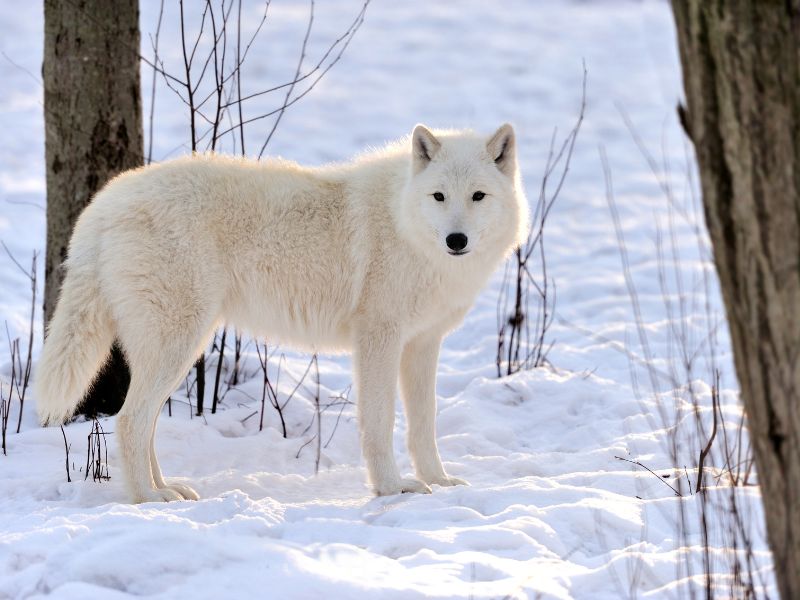
In the quiet hush of dawn, when the veils between the worlds are thin, I have sometimes heard the howl of the ancient ones—those creatures whose bones whisper through the roots of the earth and whose spirits linger in the forgotten places. The dire wolf, Canis dirus, long extinct, has been one such presence—an echo of a world before ours. And now, through the craft and curiosity of modern science, this ancient being has returned, drawn forth not by magic or myth but by the gleaming edge of a CRISPR needle.
It would be easy for one like me, who has walked the winding paths of Druidry, to react with caution—perhaps even dismay—at the manipulation of life at such a fundamental level. The natural order, after all, is sacred. But the sacred is not stagnant, and in Druidic wisdom, we are taught to be observers and interpreters of the cycles, to read the signs of the times, and to respond not with fear but with discernment.
And so I sit beneath my ironwood tree, the wind humming through the desert as it once did through pine forests long lost. I reflect on the return of the dire wolf—not merely as a biological novelty, but as a symbol, a spiritual messenger for these times.
The Dire Wolf as Ancestor Spirit
To many, the dire wolf was a relic—massive, powerful, and vanished along with mammoths and sabretooths. But in the Druid’s eye, every creature is a thread in the great web of life, and no thread is ever truly lost. The dire wolf is not just an extinct species but an ancestor. Its return is a triumph of science and a spiritual event—a resurfacing of ancient memory.
In Celtic tradition, the wolf symbolizes wild instinct, fierce loyalty, and the deep wilderness within the soul. The dire wolf, even more so, becomes an archetype of primal knowledge—what we might call the knowing before knowing. Its reappearance in our world reminds us that the wisdom of the old ones is never gone. It only sleeps.
This act of resurrection is not merely technological; it is, perhaps unknowingly, an invocation. Whether scientists understand it or not, they have performed a rite—calling the spirit of the past into the flesh of the present.
Sacred Restoration or Hubris?
Yet we must ask ourselves: Is this a proper restoration or an act of hubris?
From the Druidic perspective, all things must be weighed on the balance scale. Bringing back a species—especially one that lived in ecosystems long since transformed—is not a trivial matter. It demands more than scientific skill; it requires spiritual humility. As history has shown us time and again, wielding the tools of creation without reverence leads to imbalance.
If this revival of the dire wolf is done with care—for the land, the ecosystems, and the animal’s spirit—then it may become a form of sacred restoration, a healing of the long-rent fabric of the world. But if it is done for spectacle, power, or pride, it risks becoming another wound, this time inflicted in the name of progress.
Messages from the Wild
There is a deep symbolism in the fact that, of all creatures, the dire wolf is the one called back. Wolves are social animals. They teach us about community, hierarchy, cooperation, and the importance of each pack member. They live by code and instinct, not by greed or ambition.
The return of the dire wolf may be a message to us.
In a time when we are more disconnected than ever from one another and the wild soul of the Earth, the dire wolf brings back a lesson written in fang and fur: Remember who you are. Remember what it means to belong—to a family, land, and the great circle of life.
We, too, are part of a pack, whether we see it or not. And if we continue to live as if we are separate from nature, we may find ourselves extinct in all the ways that matter.
The Druid’s Blessing
So I offer a Druid’s blessing for the dire wolf, reborn of both code and spirit:
May you run again beneath moonlit skies, not as a curiosity, but as a sovereign of the wild. May those who created you remember their duty to the Earth and you. May your howl awaken the ancient memory within our bones, And remind us that the past is never truly gone—it is merely waiting to be heard again.
Ultimately, whether this moment becomes a mythic act of healing or a cautionary tale is up to us. But for now, the dire wolf walks again. And in that footstep, heavy and sure, there is both wonder and warning. As Druids, we are called to witness—and to guide. Let us walk beside the old ones, not ahead of them.
Remember that true power lies not in domination but in reverence.


 Joyful Aspen
Leave a comment