
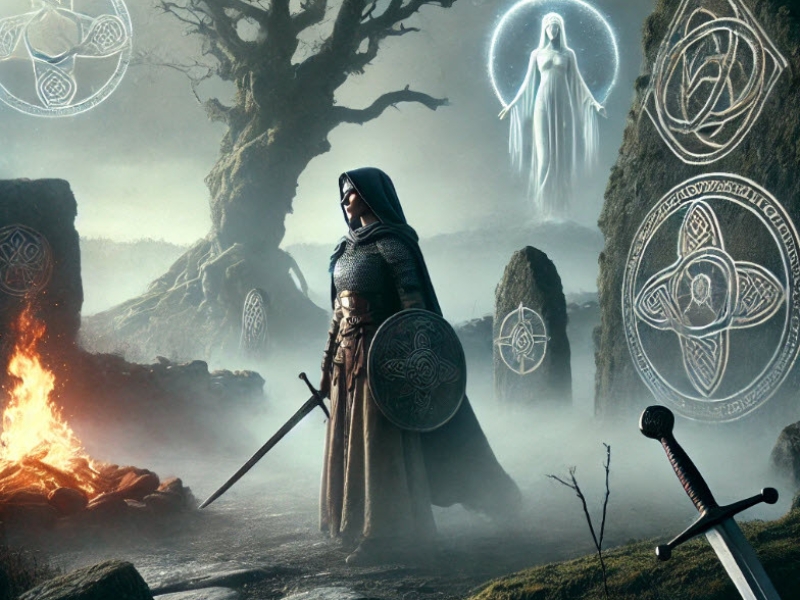
I’ve been watching a series called The Last Kingdom and have been struck by the character Hild. She is a nun, and in one episode, she prevents the rape of a village woman. At that moment, she decides she will never be a victim or martyr and takes up a sword to become a warrior.
In a world where the balance of power often tips against women, there is an ancient call that beckons from Celtic mythology—a call to women to rise in their sacred strength and to men to stand as allies in the pursuit of justice. This call, rooted in Druidic tradition and embodied by the powerful Celtic goddesses, urges women and men to step into their roles as protectors of righteousness, equality, and balance. In this sacred space, the archetype of the “warrior nun” emerges as a woman dedicated not only to spiritual service but also to the defense of her rights and the rights of others.
By invoking the stories of Celtic goddesses—Brigid, Macha, the Morrígan, Scáthach, and Ériu—we rediscover the fierce feminine power that has long stood as a beacon for justice and sovereignty. In their stories, we find timeless inspiration for modern women to take up the mantle of holy righteousness and for men to lend their strength in support.
The Sacred Role of Warrior Nuns in Druidry
Though nuns are commonly associated with Christian monasticism, within the context of Druidry, we might reimagine the term to represent women who are guardians of sacred wisdom, life, and justice. These “warrior nuns” are not cloistered behind walls of silence but stand in the open fields of the world, where they defend what is just and holy.
In ancient Celtic society, women often held positions of great power. They were warriors, queens, and wise women whose counsel and actions were sought after in both times of peace and war. As we explore her in this context, the warrior nun is a contemporary embodiment of this ancient power. She is a spiritual leader, protector of the vulnerable, champion of the earth, and fierce advocate for justice.
Brigid: The Triple Flame of Creation and Justice
No discussion of Celtic goddesses can begin without Brigid (or Brighid), the great triple goddess of healing, poetry, and smithcraft. Brigid’s power comes from her mastery over creation in all its forms. She heals the wounded, inspires the oppressed, and forges the tools necessary for transformation. But Brigid’s sacred flame is not merely one of creation—it is also a flame of righteous justice.
Her festival, Imbolc, celebrated on February 1st, marks the beginning of the light returning to the land after winter’s darkness. It is when fires are lit in her honor, symbolizing purification and empowerment. Brigid’s role as a goddess of justice makes her a powerful symbol for modern women standing up against oppression, as her flame represents the light of truth that cuts through injustice.
Macha: The Fierce Sovereign of Female Power
Macha, the goddess of war and sovereignty, symbolizes oppression’s dangers and retribution’s power. In her most well-known legend, Macha is forced to race against horses while heavily pregnant, her pleas for mercy ignored by the men of Ulster. After winning the race, she collapses, giving birth to twins, and curses the men of Ulster with labor pains at their time of greatest need. Macha’s story is a cautionary tale: when women’s rights are trampled, there are dire consequences.
But more than a symbol of vengeance, Macha is a goddess of sovereignty. She represents the land and the women who, like the earth, are often treated as objects to control. Macha reminds women today that they are sovereign beings, possessing full autonomy over their bodies, lives, and choices. Her fierce spirit calls for a reclamation of that sovereignty, while men are called to respect and honor this sacred autonomy.
The Morrígan: The Goddess of Fate and Battle
The Morrígan, the Phantom Queen, is perhaps the most enigmatic and powerful of the Celtic goddesses. Associated with prophecy and war, she is a shapeshifter who guides the fate of battles and protects the balance between life and death. The Morrígan is not simply a goddess of destruction—she ensures that endings give way to new beginnings and that justice is done even in the harshest circumstances.
For women today, the Morrígan offers a model of transformative power. She teaches that to fight for justice, one must be willing to face the darkness, embrace the inevitability of change, and stand firm even when the odds seem insurmountable. For men, the Morrígan’s presence serves as a reminder of the sacred duty to protect what is right, not through domination but through partnership with the feminine force of life itself.
Scáthach: The Warrior and Teacher of Heroes
Scáthach, whose name means “shadowy,” is the great warrior woman and teacher of heroes in the Ulster Cycle. She trains the legendary Cú Chulainn in the arts of war, bestowing him the knowledge and skills to make him a great warrior. Scáthach’s role as a teacher emphasizes that strength is not merely physical—it comes from wisdom, discipline, and mastery over one’s self.
For modern women, Scáthach offers the gift of self-discipline and the reminder that true power comes from within. Her teaching spirit encourages women to hone their skills, trust in their wisdom, and fight with both intelligence and heart. Men, too, can learn from Scáthach’s lessons, supporting women by honoring their strength and wisdom rather than attempting to control or suppress them.
Ériu: The Goddess of Sovereignty and Land
Ériu, one of the three goddesses of Ireland, represents the land and its people’s sovereignty. When the Milesians arrived to claim Ireland, Ériu negotiated the terms of their rule, ensuring that her land would remain sacred and protected. Ériu’s story is one of diplomacy and wisdom, and she stands as a symbol of the sacred relationship between the earth and its people.
For women, Ériu reminds us that sovereignty is not just a political concept but a sacred right. Women’s connection to the earth, the cycles of nature, and the preservation of life is a powerful force that must be respected. Men, in turn, are called to support this sacred sovereignty, to stand as protectors of the land and the women who embody its spirit.
Men as Allies in the Sacred Battle
In ancient Druidic culture, men and women were considered partners in maintaining balance. Men were warriors, protectors, and leaders, but their strength was not meant to dominate but to support the sacred feminine. Today’s men are called to take up this mantle again, to stand beside women as allies in the fight for justice.
Men can draw inspiration from gods like Lugh, the god of skill and light, who used his talents not for personal gain but to protect his people. By embracing their role as protectors of women’s rights and dignity, men can honor the balance between the masculine and feminine at the heart of the Druidic tradition.
A Call to Action
As we look at the stories of Brigid, Macha, the Morrígan, Scáthach, and Ériu, we are reminded that the fight for justice is not new—it is ancient, sacred, and ongoing. As a modern embodiment of these powerful goddesses, the warrior nun symbolizes feminine righteousness, holy in her determination and unwavering pursuit of balance.
Today’s women are called to take up this mantle and fight for their rights with the same fire and wisdom as the goddesses who came before them. And men, standing as allies, are called to strengthen this sacred battle, ensuring that justice, equality, and sovereignty prevail.
Together, in partnership, we can honor the divine balance that has always existed and protect the sacred power in every woman, every man, and every corner of the earth. The call has been made—let us answer it with righteous hearts and unyielding spirits.
Pronunciation Guide for Celtic Goddesses
- Brigid (Brígh): BREE-jid or BREE-d
- Note: The name can vary regionally, with some areas pronouncing it as “Breed.”
- Macha: MAH-kha
- Note: The “ch” is pronounced like the “ch” in the German “Bach” or the Scottish “Loch.”
- The Morrígan: MOHR-ree-gan
- Note: Emphasis is on the first syllable, and the “rr” can be slightly rolled.
- Scáthach: SKAH-thakh
- Note: The “th” is soft, and the final “ch” is pronounced like in “Bach” or “Loch.”
- Ériu: AIR-ee-oo
- Note: The first syllable resembles the English word “air,” with a soft “u” sound at the end.


 Joyful Aspen
Leave a comment